
Track
Hockenheimring "GP Strecke"
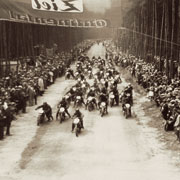 |
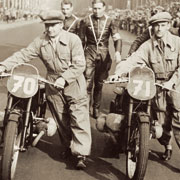
The Hockenheimring is one of the most modern race tracks in the world, and yet one of the oldest ones. It's been since 1930 that the young Ernst Christ came up with the idea to build a race track in his hometown Hockenheim. He got the support of the then mayor Philipp Klein. Two years later, the first motorcycle race was finally held at Hockenheim. We write 1932. For lack of money, the then 12 km long "Dreieckskurs" was an unhardened road. |
 |
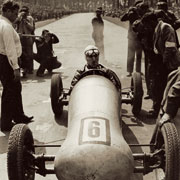 |
The long straights were typical for the left turning track that was shortened to 7,7 km in 1938. It was widened and the "Ostkurve" was build. That way, the famous oval form of the track was created and was kept until 2001. The name was changed to "Kurpfalzring". During WW II, the road-surface was heavily dammaged by the tanks of the Allied Forces. After the repair, the name was changed again. And thus the "Hockenheimring" was created where from 1947 races were organised again. |
 |
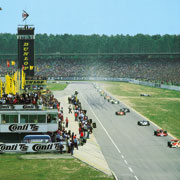 |
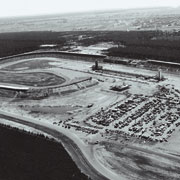
At the beginning of the '60's, a large part of the track has to disappear for the new "autobahn". The Dutch designer John Hugenholtz is inspired by Indianapolis... the "Motodrom" is a fact. In 1964 the rebuilding started and in 1966 the track was re-opened. The desolate, long straights trough the woods and the winding stadium part packed with spectators become characteristic for this 6,8 km long, right turning version of the Hockenheimring. |
 |
 |
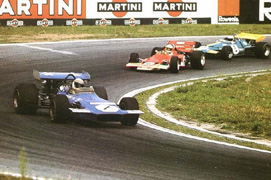
In 1968, the legendary Jim Clark, double world champion F1, crashes and dies on one of the long straights during a F2 race. In 1970, half-way both long straights, chicanes are build to improve safety. During that same year - because of safety issues at the Nürburgring - the German GP F1 takes place for the first time at the Hockenheimring. This race is won by Jochen Rindt who crashes and dies a year later at Monza being world champion at that time. |
 |
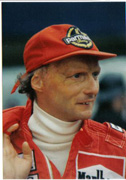 |
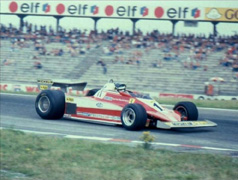
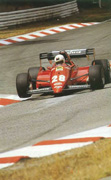
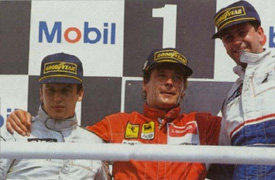
The year after that, the German GP again takes place at the Nürburgring, but after the accident of Niki Lauda in 1976, F1 returns to Hockenheim a year later. With the exception of 1985, it stayed there until now. In 1982, a new chicane is added, just before the "Ostkurve". Now there are the "Bremskurve" 1, 2 and 3. The last big change dates from 1994, when Gerhard Berger won, after the dramatic weekend at Imola (crash Senna & Ratzenberger). |
 |
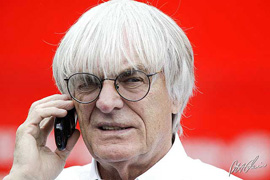 |
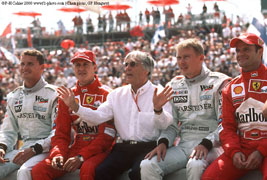
The 1st and 3rd chicane were made slower and their names were changed to resp. the "Jim Clark" and the "Ayrton Senna" chicane. At the end of the '90's, Ecclestone wanted the track length to be reduced so the spectators could see the cars come by more often. |
 |
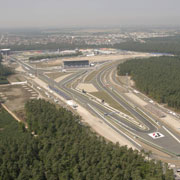 |
If not, Hockenheim would loose the German GP F1. The German engineers office of Hermann Tielke designed a completely new part that replaced the long straights and the "Ostkurve". To compensate all the cut-down trees, new trees were planted on the old part. This way, the typical oval form of the track had definitively disappeared. |
 |
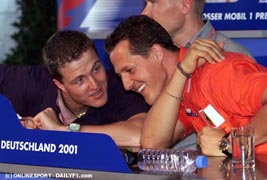 |
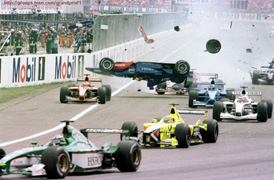
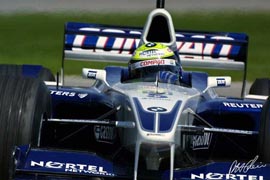
The last Grand Prix at the "old" Hockenheim was run in 2001 and won by Ralf Schumacher with an average speed of 235 km/hr. The highest topspeed ever was reached in 2000 by David Coulthard on the long straight of 1,5 km : 361 km/hr. |
 |
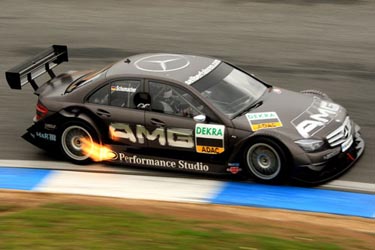 |
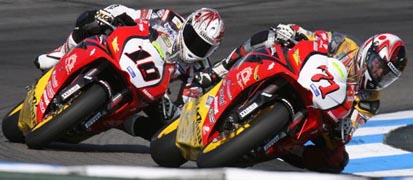
Now, besides the German GP F1, also the very popular DTM and the thrilling IDM are organized at the ultra-modern Hockenheim.
 |